
Build Advanced AI Systems with Deep Learning
Oodles designs and delivers production-ready deep learning solutions using Python, TensorFlow, PyTorch, Keras, Hugging Face Transformers, CUDA, and distributed GPU infrastructure. We build intelligent systems powered by convolutional networks, recurrent architectures, and transformer models that enable computers to see, language models to reason, and AI systems to learn complex patterns at scale. From large-scale model training to optimized inference pipelines, our deep learning engineering focuses on accuracy, scalability, and real-world deployment.
What is Deep Learning?
Deep Learning is a specialized branch of machine learning that uses multi-layer artificial neural networks to automatically learn hierarchical representations from large volumes of data. These models are implemented using frameworks such as TensorFlow, PyTorch, and Keras and trained efficiently using GPU-accelerated computing with CUDA and distributed training frameworks.
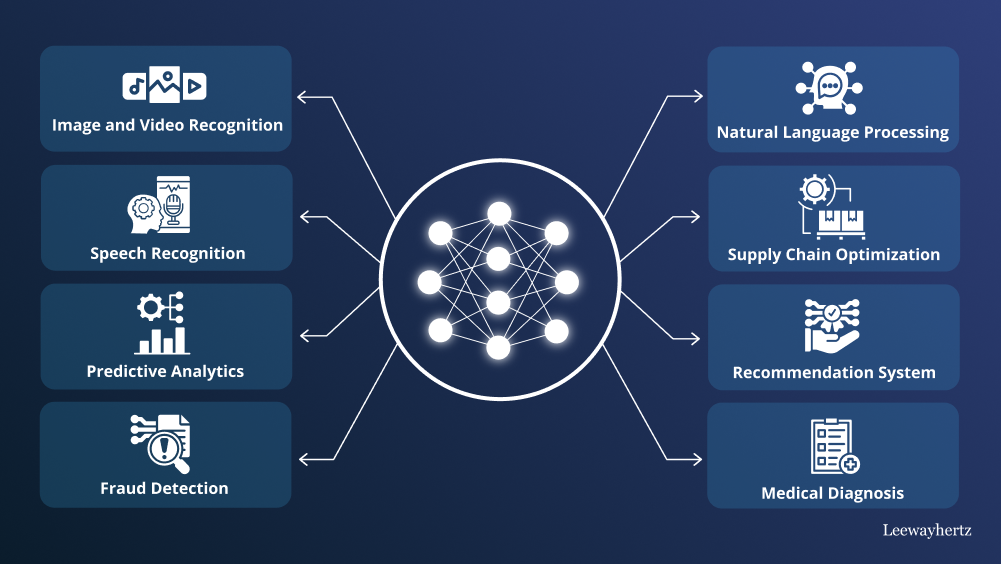
Deep learning architectures such as CNNs, RNNs, LSTMs, Transformers, GANs, and Diffusion Models power modern AI systems across computer vision, natural language processing, speech recognition, and generative AI.
Deep Learning Development Pipeline
Data Collection
Structured and unstructured datasets ingested from APIs, databases, cloud storage, and large-scale training corpora.
Preprocessing
Data cleaning, normalization, augmentation, and feature preparation using NumPy, Pandas, OpenCV, and data pipelines optimized for deep learning workloads.
Deep Model Training
Training CNNs, RNNs, Transformers, GANs, and Autoencoders using TensorFlow, PyTorch, Keras, accelerated by GPU/TPU infrastructure.
Evaluation
Model evaluation using accuracy, precision, recall, F1-score, ROC-AUC, and validation techniques commonly used in deep learning training workflows..
Deployment & MLOps
Deployment of trained deep learning models for inference with monitoring, retraining, and lifecycle management. with continuous monitoring, retraining, and MLOps workflows.
Core Deep Learning Architectures
Convolutional Neural Networks (CNNs)
Image recognition, computer vision, and object detection using TensorFlow Vision, PyTorch Vision, OpenCV, and CNN-based architectures.
Recurrent Neural Networks (RNNs/LSTMs)
Sequence modeling, time-series analysis, and NLP using LSTM, GRU, and recurrent models implemented in TensorFlow and PyTorch.
Transformer Architectures
Large language models, attention mechanisms, and generative architectures built using transformer-based neural networks and vision transformers.
Industry-Specific Deep Learning Applications
Computer Vision & Image Recognition
Advanced image classification, object detection, and medical imaging using CNNs, vision transformers, OpenCV, TensorFlow, and PyTorch.
Natural Language Processing
Language understanding, translation, chatbots, and text generation using Transformers, Hugging Face libraries, and deep NLP models.
Speech Recognition & Synthesis
Voice assistants, speech-to-text, and text-to-speech using deep neural networks, spectrogram models, and GPU-accelerated training.
Generative AI & Content Creation
Image and text generation using GANs, VAEs, diffusion models, and large language models.
Ready to build Deep Learning solutions? Let's talk






We are ISO 9001:2015 Certified
Connect with us


Follow us